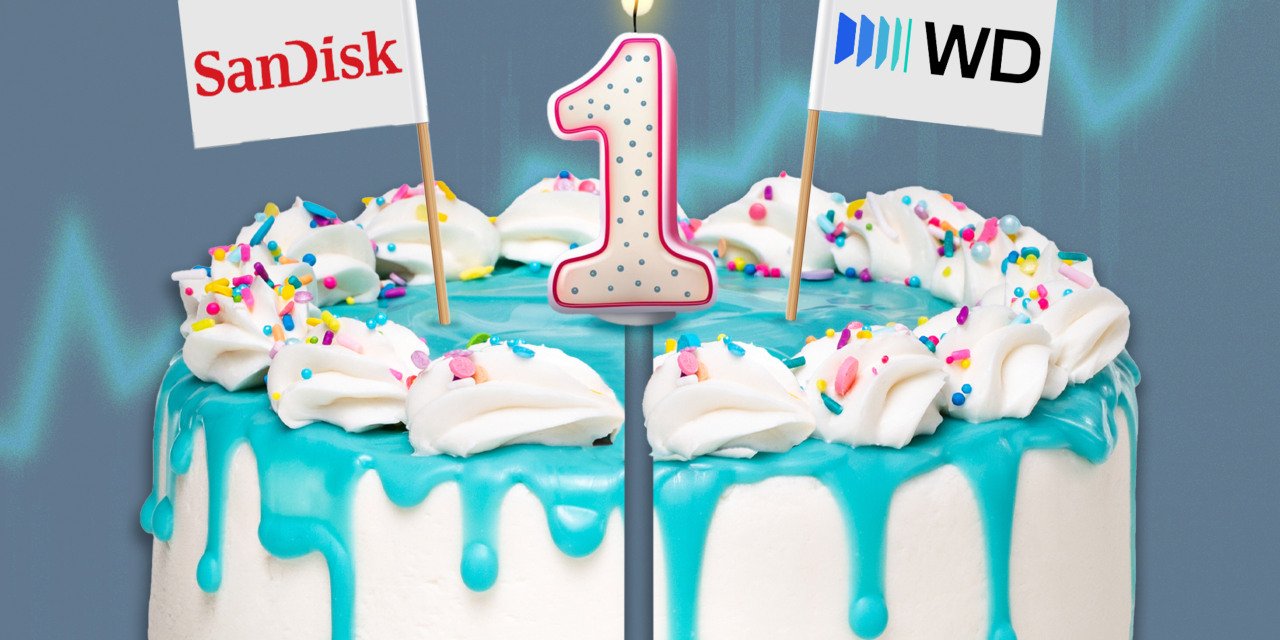
Breakups are usually messy. Corporate breakups? Catastrophically so. They drag on for years, bleed fortunes in legal fees, and typically leave shareholders clutching a noticeably lighter bag. But every once in a while, a split lands at the exact right moment in history — and the timing alone is worth billions.
Per MarketWatch, one year after carving themselves into two distinct businesses, Western Digital and Sandisk have both pulled off something genuinely improbable. Knockout stock performances, back to back, from a divorce that Wall Street initially greeted with a collective shrug. And it isn’t simply because they trimmed some middle-management fat. It’s because they accidentally synchronized their corporate uncoupling with the most voracious technology supercycle in recent memory: artificial intelligence.
Cast your mind back to early 2025, when the split was finalized. Skepticism was the prevailing mood. Fracturing a massive data storage conglomerate into two smaller pieces felt defensive — a retreat dressed up as strategy. As of February 2026, that skepticism looks, frankly, embarrassing. The insatiable appetite for AI memory and storage products has essentially strapped a rocket booster to both newly independent companies, and neither shows signs of coming back down.
Would things look this rosy had they stayed together? Almost certainly not.
Would that still be the case if the companies remained as one? Western Digital CFO Kris Sennesael doesn’t quite think so.
Britney Nguyen, MarketWatch
He’s right. Here’s why it matters.
Two Different Beasts, One Expensive Cage
To grasp why this breakup worked, you first need to understand why they ever merged. Western Digital acquired Sandisk in 2016 for $19 billion — a figure that raised eyebrows even then. The logic was defensible, if not exactly inspired. WD manufactured hard disk drives (HDDs), those spinning magnetic platters engineered to store colossal volumes of cheap data. Sandisk, meanwhile, fabricated flash memory (NAND) — the fast, solid-state storage powering smartphones, cameras, and high-performance laptops.
The investor pitch was seductively clean: one sprawling company covering every conceivable storage need on the planet.
The lived reality? A bloated giant waging a two-front war against itself. Manufacturing spinning disks demands an entirely different supply chain, engineering culture, and capital expenditure philosophy than etching microscopic flash memory cells onto silicon wafers. When one division posted a strong quarter, the other was typically mired in a cyclical rut — dragging the overall stock price down like an anchor. Wall Street punishes that kind of internal friction with what analysts call a “conglomerate discount”: a structural markdown applied to companies that lack a singular, legible focus. Splitting them up dissolved that discount overnight. Suddenly, investors could buy precisely what they wanted. And buy they did.
A Scalpel, Not a Swiss Army Knife
Managing a billion-dollar fund requires precision instruments. When the separation finalized, Western Digital emerged as a pure-play enterprise storage company. Sandisk returned to its origins as a dedicated flash memory business. Clean. Legible. Priceable.
That clarity let the market accurately assign value to both assets. And as it turned out, both assets were perched on a goldmine neither had fully recognized while sharing a balance sheet.
How AI Accidentally Rescued Two Storage Companies
GPUs get the glory. Nvidia collects the magazine covers, the breathless earnings calls, the memes. But a GPU is just an engine — and engines need fuel. For AI, that fuel is data. Petabytes of it. Exabytes. Numbers that stop feeling real after a while.
Large Language Models don’t conjure knowledge from thin air. They are trained on datasets of staggering density that must physically reside somewhere, get retrieved at speed, and stream into processors without creating bottlenecks. According to a 2025 report from Gartner, global spending on AI-driven data center storage surged by over 40% in a single year. Every image, every scraped article, every training video needs a home — and someone has to build the shelves.
This created a two-pronged demand shock, hitting both companies simultaneously but differently.
First prong: the cloud titans needed effectively infinite, cost-efficient storage to house the “data lakes” feeding their model training pipelines. That’s squarely Western Digital’s territory. High-capacity hard drives remain the most economical way to archive colossal volumes of cold data. The technology isn’t glamorous — spinning magnetic platters haven’t fundamentally changed in decades — but the profit margins, in practice, are striking.
Second prong: the training process itself demands memory that can feed data to GPUs without throttling the system. That’s Sandisk’s domain. Their NAND flash technology is non-negotiable infrastructure for high-performance enterprise solid-state drives (SSDs). When actually tested against the throughput demands of modern AI workloads, the gap between commodity storage and purpose-built flash memory becomes impossible to ignore.
Both companies were suddenly fielding orders from the largest tech operations on earth. Crucially, because they were separated, each could respond to its specific market without requiring the other’s sign-off on budget or strategy. Agility, it turned out, was worth more than consolidation.
Your Pocket Is Now a Data Center — And Sandisk Noticed
The AI story has migrated. It’s no longer exclusively about humming server farms in the Nevada desert. Over the past year, the conversation has shifted hard toward “edge AI” — running artificial intelligence directly on your phone, your laptop, your car — rather than bouncing requests off a distant cloud server.
Faster. More private. Harder to build. And extraordinarily hungry for local memory.
When Apple, Samsung, and Google began aggressively pushing on-device AI through late 2024 and into 2025, baseline storage requirements for consumer devices shot upward almost overnight. A handset that ran perfectly well on 128 gigabytes of storage suddenly strained at 512. The hardware goalposts moved, and they moved fast. (It’s worth noting that this shift caught several mid-tier device manufacturers genuinely flat-footed — a reminder that supply chain positioning matters as much as product design.)
Sandisk was already standing in the right spot. Untethered from Western Digital’s legacy hard drive business — and its competing claims on capital — Sandisk could direct every available dollar toward next-generation flash memory fabrication. No justifying R&D expenditures to a board simultaneously worried about HDD market share. No internal horse-trading over which division gets the bigger slice of the budget. Just focused, unimpeded investment in the technology the market was screaming for.
The data reinforces the scale of what’s happening. According to Statista, the total volume of data created globally hit an estimated 147 zettabytes in 2024 — a figure so large it starts to lose meaning until you consider the physical infrastructure required to contain it. Sandisk, in effect, manufactures the buckets. The rain isn’t stopping anytime soon.
Silicon Valley Is Taking Notes — Whether It Admits It or Not
Other tech executives are watching. You can be certain of it.
For the better part of a decade, the prevailing gospel in tech was consolidation. Acquire rivals. Absorb adjacent capabilities. Build moats so wide that competitors exhaust themselves trying to cross. Scale was the answer to every question. But as AI accelerates the pace of hardware evolution to something genuinely uncomfortable, agility is suddenly commanding a premium that sheer size cannot match.
Whispers of similar restructuring moves are already circulating through global tech manufacturing sectors. Companies providing critical infrastructure for the AI wave are quietly reassessing whether they’re better valued as specialized standalone entities than as sprawling conglomerates. The Western Digital-Sandisk outcome is the case study everyone is passing around.
What’s genuinely fascinating here is the psychological pivot in how institutional investors are thinking. The “total solution” provider — once the most reassuring pitch in enterprise tech — has lost its luster. What the market wants now is the undisputed, best-in-class specialist for one specific chokepoint. Western Digital owns bulk data archiving. Sandisk owns high-speed flash. Neither has to apologize for what it doesn’t do.
By splitting, they didn’t merely survive the AI revolution. They carved out sovereign territory inside it.
Frequently Asked Questions
Why did Western Digital and Sandisk split?
The companies separated to allow each distinct business unit — traditional hard drives (Western Digital) and flash memory (Sandisk) — to operate without the drag of the other’s priorities. This dissolved the “conglomerate discount” Wall Street had been applying and freed each company to concentrate its R&D and capital exclusively on its own specialized technology and market.
How does AI affect the demand for storage?
Artificial intelligence requires enormous volumes of data for both training models and running inference at scale. That creates surging demand on two fronts: high-capacity hard drives to archive raw data lakes, and ultra-fast flash memory to stream that data into AI processors without creating performance bottlenecks. Both needs are growing — and show no sign of plateauing.
Was the split successful?
By most measurable standards, yes. One year after the separation, both companies have posted exceptional stock performance, driven by their ability to move quickly and capture distinct segments of the AI hardware market — something that would have been structurally harder, and politically messier, as a single combined entity.
Reporting draws from multiple verified sources. The editorial angle and commentary are our own.