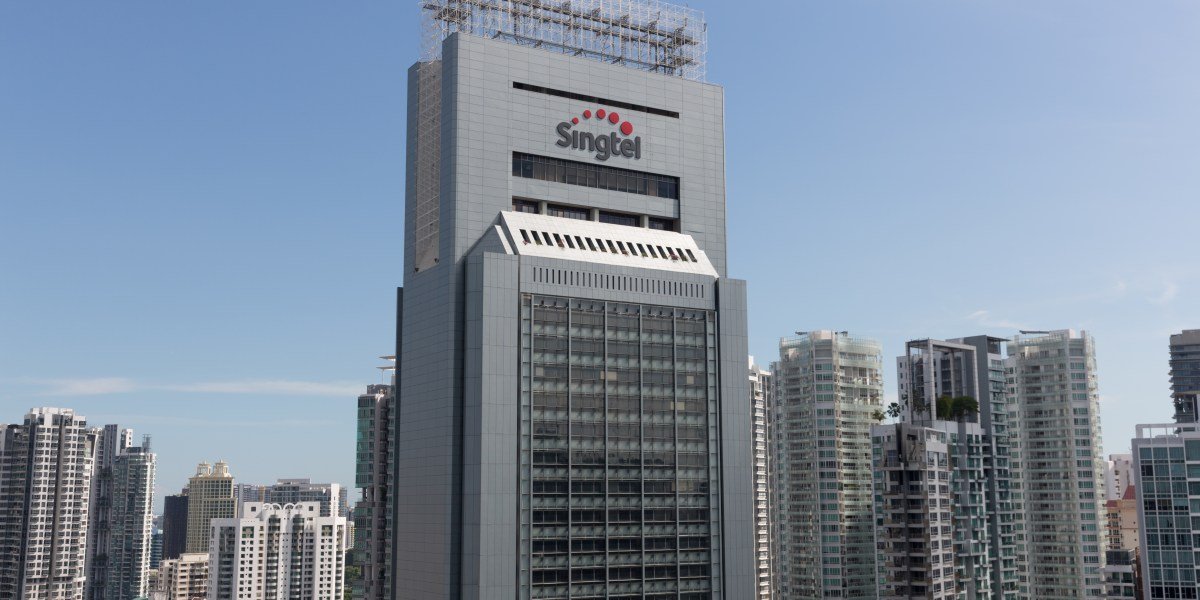
It happened slowly, and then all at once. The company that literally wired Singapore back in 1879 is officially done betting its future on your phone plan. And honestly? You can’t blame them for wanting out.
According to Fortune, Singtel dropped a hard-to-ignore announcement on the tech industry this week. The telecom giant confirmed a deep-rooted partnership with U.S. chip behemoth Nvidia to construct a specialized “center of excellence” aimed squarely at artificial intelligence. But this isn’t just another corporate press release about procuring more processing power — as of mid-2025, it reads more like a survival document. A fundamental rewiring of what a telecommunications company actually does in the twenty-first century.
The balance sheet tells a blunt story. Between April and December of last year, Singtel’s mobile service revenue in its home market collapsed by 10.1%. Overall revenue slipped 0.5% across that same window. The official PR framing blamed “intense price competition,” which holds some water. But anyone with a smartphone already knows the real story.
WhatsApp, Telegram, and Zoom have systematically gutted the traditional telecom business model. Voice calls? Finished. SMS? A relic. The multi-billion-dollar infrastructure Singtel assembled over decades has effectively become a series of dumb pipes — invisible highways that other people’s enormously profitable apps ride across for free. Despite holding over 4 million subscribers as of March 2025, the 147-year-old company was staring down the barrel of long-term irrelevance.
So they decided to become the landlords of the AI revolution instead.
Data Sovereignty Is the New Border War — and Singtel Just Picked a Side
Enter data sovereignty. It sounds like a dusty legal abstraction, but it has rapidly become the single most combustible concept in global technology.
Not long ago, the tech world ran on a seductively simple premise: throw everything into the cloud. Nobody particularly cared whether a server physically sat in Virginia, Dublin, or Tokyo. The internet felt borderless, frictionless, permanent. Then generative AI arrived — and that comfortable assumption shattered.
Governments and large enterprises are now genuinely alarmed. When you feed proprietary banking algorithms, classified government directives, or millions of citizen health records into a large language model, you absolutely cannot afford that data drifting across national borders. You want it locked down. You want to know exactly which building it occupies, who holds the keys, and which country’s laws govern every byte of it.
Localizing data is no longer a paranoid luxury indulged by cautious legal teams. It is becoming a hard legal mandate. Scan the global tracking of cyber laws maintained by UNCTAD and you’ll see an unmistakable surge — nation after nation enacting aggressive data protection legislation that severely restricts cross-border data transfers. The wave isn’t cresting. It’s still building.
Singtel knows this. Nvidia knows this.
“AI is becoming more embedded in decision-making, and government entities and enterprises… need assurance that their data is protected,” Bill Chang, CEO of Singtel Infraco, told reporters during a press briefing this week.
A 2024 survey by Gartner found that over 60% of enterprise leaders identified data privacy and security as the primary friction points blocking generative AI deployment at scale. Banks covet the predictive power of AI, but they cannot absorb the reputational — and legal — catastrophe of a data breach. Hospitals desperately need AI diagnostic tools, yet patient confidentiality laws make public cloud models a non-starter. What every one of these organizations craves is a localized, rigorously secured sandbox where they can actually work.
That is precisely what this new research lab — targeted to open this coming June — is engineered to deliver.
Nvidia’s Quietly Brilliant Real Estate Play
Nvidia’s role here is the crucial hinge of the whole arrangement. Over the past few years, the company has been seeding AI research facilities across Asia, Europe, and the Middle East with quiet consistency — systematically embedding itself into local infrastructures before the demand fully crystallizes.
Why anchor that strategy to a legacy telecom company? Why not simply construct their own data centers?
“Chips are just the second layer of the cake, the third layer that you need is AI infrastructure.”
— Marc Hamilton, Nvidia’s Vice-President of Solutions Architecture and Engineering
Hamilton’s observation at the center’s Singapore launch cuts straight to the point. Telecommunications companies occupy the most valuable, heavily zoned, power-rich real estate on the planet — often without anyone outside the industry fully appreciating it. They own submarine cable landing stations. They hold decades-old connections to national power grids. Securing land, navigating industrial zoning, and wrestling permits for a sprawling AI facility can consume years. Partnering with a legacy telco sidesteps most of that bureaucratic friction in one move.
A trillion-dollar consignment of GPUs is, at the end of the day, just a pile of extraordinarily expensive space heaters if the specialized physical environment required to run them doesn’t exist. Nvidia understands this with unusual clarity.
And the physical environment that AI demands? Unlike anything we have previously constructed.
The Power Densities That Are Quietly Terrifying Engineers
Consider the raw physics of artificial intelligence for a moment. They are unforgiving.
The new Singtel-Nvidia facility is tasked with prototyping data centers engineered to handle power densities ranging between 600 kilowatts and a staggering 1 megawatt per rack row. For anyone outside the data center world, here’s the honest translation: that figure sits up to 100 times higher than what a typical cloud facility operates at today. One hundred times.
One megawatt concentrated into a single row of server racks generates a terrifying quantity of heat — the kind that turns conventional cooling approaches into a bad joke. Industrial fans won’t touch it. Cranking up the air conditioning accomplishes nothing useful. What it actually requires is entirely new liquid cooling architectures, coolant pumped directly to the silicon, and a completely redesigned electrical distribution grid. In practice, when you stand inside one of these next-generation facilities, the infrastructure surrounding the servers is often more impressive — and more expensive — than the servers themselves.
Per a comprehensive report by the International Energy Agency, global electricity consumption by data centers is on track to double by the end of this year, driven almost entirely by the relentless appetite of AI workloads.
Singtel Infraco’s VP and CTO, Manoj Prasanna Kumar, was unambiguous about the scope of the ambition. The goal is nothing less than an “AI grid” — a sprawling network of “liquid-cooled, scalable, hyper-connected, AI-ready data centers” stitched together across the region.
These aren’t server rooms. They are industrial computation plants.
Singapore, Johor, and the Quiet Geographic Chess Match No One Is Covering
This strategic pivot clarifies Singtel’s otherwise puzzling geographic aggression over the past eighteen months. The company is methodically cornering the physical bedrock of Southeast Asia’s AI expansion before competitors recognize what’s being staked out.
Capital is flowing into a major new facility in Johor, Malaysia — slated to come online in the second half of this year. A pristine data center in Tuas, Singapore recently opened its doors. Singtel also committed financial weight to a consortium led by private equity heavyweight KKR to acquire ST Telemedia Global Data Centres. Each move, viewed individually, looks like routine infrastructure investment. Taken together, they sketch a deliberate territorial map.
The logic is elegant, once you see it. Singapore functions as the hyper-secure, politically stable financial hub where the most sensitive sovereign and enterprise data will reside — the kind of jurisdiction that risk-averse governments and banks require before they’ll sign anything. Malaysia, just across the causeway, delivers cheaper land and the abundant power headroom needed to sustain megawatt-scale cooling systems. By bridging the two, Singtel assembles a comprehensive ecosystem that few regional competitors can credibly replicate. Reuters’ ongoing coverage of the AI sector has repeatedly underscored how physical infrastructure — not software — has become the defining battleground for tech dominance across Asia.
Singtel is building a moat. And they are using Nvidia’s global momentum to dig it deeper, faster.
Why the “Telco Becomes Tech-Co” Graveyard Is Full — and Why This Might Be Different
Singtel currently sits at No. 27 on the Southeast Asia 500. The company holds significant, lucrative stakes in foreign operators including Australia’s Optus and India’s Bharti Airtel — assets that generate real cash and buy real time. But accumulated prestige doesn’t insulate anyone from structural disruption. The company’s own leadership appears to grasp this with unusual candor.
The path from traditional “telco” to functioning “tech-co” is littered with the wreckage of companies that attempted exactly this transition and didn’t survive it. The capital expenditure required is genuinely eye-watering. Convincing legacy shareholders that dividend checks may shrink while the company tears out and rebuilds its technological foundation requires a persuasive narrative — and a tolerance for discomfort that institutional investors don’t always possess.
What’s the alternative, though? Bleeding mobile revenue at 10 percent annually while WhatsApp continues to absorb everything in its path?
By anchoring itself to Nvidia’s global infrastructure ambitions and directly confronting the thorny complexities of data sovereignty and megawatt power densities, Singtel is making what looks — from the outside, at least — like the only rational move remaining. It is walking away from the declining business of connecting people to one another, and committing fully to the booming business of connecting machines to their data securely, locally, and at scale.
Audacious. Expensive. Potentially visionary.
But in a sector where standing still guarantees a slow erosion into irrelevance, audacity starts to look a lot like prudence.
Source material compiled from several news agencies. Views expressed reflect our editorial analysis.